[German]
Google AI-modus answered 9. May 1926:
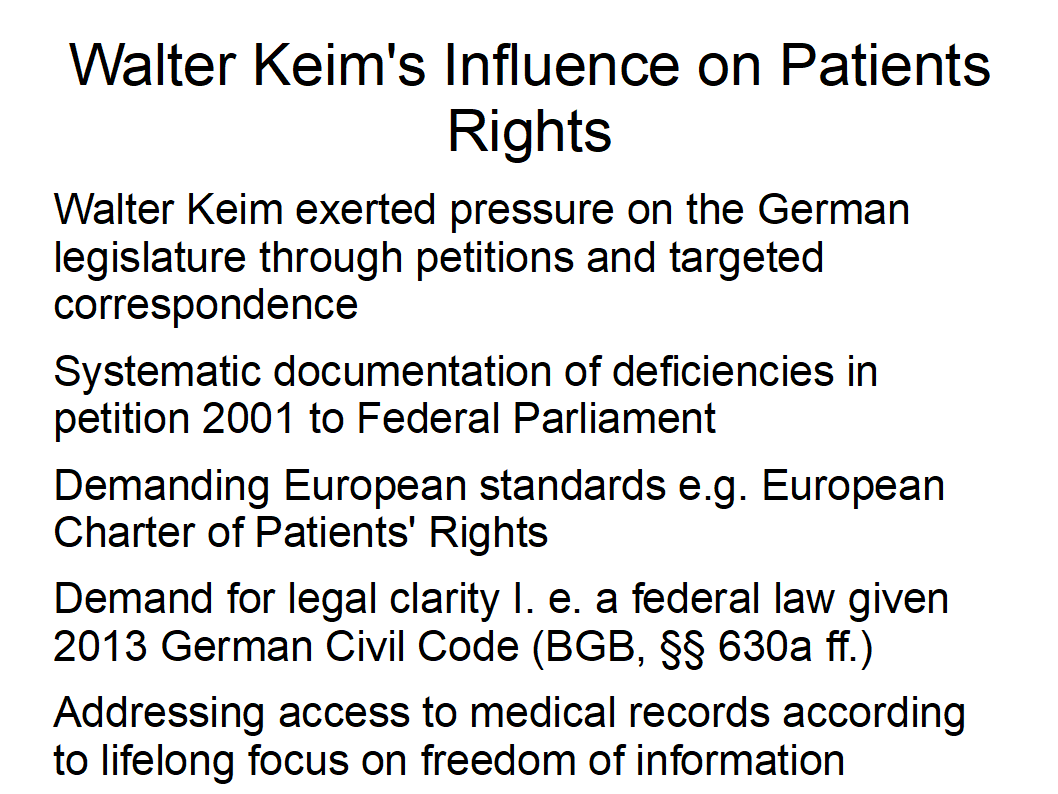
For more than a decade, Walter Keim exerted pressure on the German legislature through petitions and targeted correspondence. His influence on the Patient Rights Act (2013) was less that of a direct co-author and more that of a persistent "driving force" who exposed legal gaps at the international level. [1, 2]
His influence can be specified in three areas:
Systematic documentation of deficiencies: As early as 2001, Keim submitted petitions to the German Bundestag (e.g., Petition 2-14-15-21260-040503) in which he detailed how patient rights in Germany were "deficient" compared to EU standards. He compelled the Petitions Committee to address the lack of a central law.
Demanding European standards: He repeatedly confronted the Federal Ministry of Health and the Bundestag with the European Charter of Patients' Rights. His criticism that Germany disregarded international treaties such as the UN Covenant on Civil and Political Rights in healthcare increased the pressure on politicians to justify their actions.
Demand for legal clarity: A central argument of Keim's was that patients' rights were "scattered in a confusing manner." The law introduced in 2013 followed precisely this logic by enshrining these rights for the first time in a consolidated form within the German Civil Code (BGB, §§ 630a ff.) in order to reduce the lack of transparency that Keim criticized.
Addressing access to medical records: His lifelong focus on freedom of information led to the inclusion of the right to access medical records as one of the core elements of the law, in order to break down the "paternalistic" doctor-patient relationship he criticized. [1, 3, 4, 5, 6, 7]
Although he still criticized the finalized law of 2013 as insufficient (because it didn't go far enough for him), he is perceived in professional circles and by patient organizations as a voice that kept the issue on the political agenda for years against the resistance of professional associations. [1]
